Development History
A Houston Hidden Jewel
Lindale Park: One of Houston's Earliest Master-Planned Communities
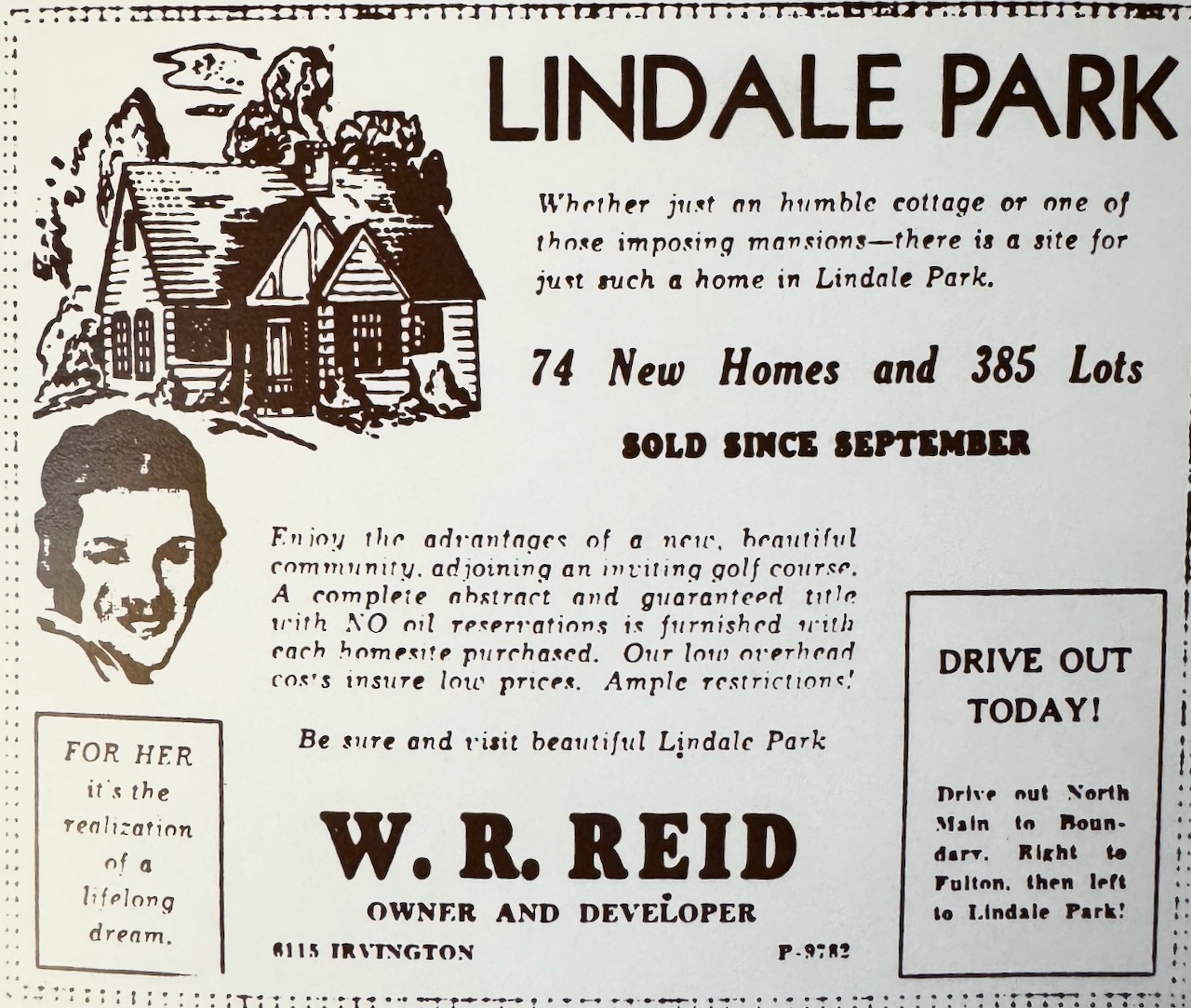
For over 88 years, Lindale Park has served as a prestigious Houston neighborhood. In 1937, developer W. Roy Reid purchased 301 acres to create an affordable community surrounded by timber. The original development was positioned near Linder Lake and the existing Lindale Golf Course, offering a resort-like setting. The subdivision extended on both sides of Irvington Boulevard, with frame homes on the east and brick homes on the west. From the start, the community featured deed restrictions and an active Civic Club.
Post-World War II Houston's expansion required significant changes. Following the developer's sale of his interest, the golf course was gradually subdivided for additional housing and Loop 610 construction. Linder street was lost to the 610 construction, and the neighborhood split in two into Lindale Park and North Lindale.
The community now encompasses over 1,300 homes and multi-family residences. During the 1970s, the neighborhood faced challenges as original residents departed. Deed restrictions lapsed and the Civic Club became inactive. Rising crime and increased rental properties marked a difficult period. However, residents responded by organizing crime prevention initiatives, reinstating deed restrictions, and reactivating the Civic Club.
Today, Lindale Park blends historic character with modern vitality, representing Houston's pioneering master-planned community through nearly nine decades of growth.
Notable Residents: A Neighborhood That Attracts Leaders
Lindale Park has consistently drawn residents engaged in public service and community leadership.
Political Leadership
The neighborhood has been home to prominent elected officials shaping Houston and Harris County policy, including Adrian Garcia (Harris County Precinct 2 Commissioner), U.S. Congresswoman Sylvia Garcia (Texas's 29th Congressional District), and Mario Castillo (Houston City Council District H). Former residents include State Representatives Jessica Farrar, Roman Martinez, and Diana Davila Martinez, along with Alfred J. Hernandez, Houston's first Hispanic judge and former national president of the League of United Latin American Citizens.
A Tradition of Civic Engagement
These public servants reflect the neighborhood's broader culture of community involvement. Residents consistently take leadership roles in local organizations and city governance, extending their commitment to neighborhood preservation into broader Houston service.
Continuing the Legacy
Today's Lindale Park continues attracting residents valuing community involvement and public service, maintaining its appeal as a home base for those working to improve the region.
Preservation Efforts: Protecting Our Community Character
Community preservation efforts have maintained Lindale Park's distinctive character and quality of life. Learn more here.
Restoring and Enforcing Deed Restrictions
In the 1980s, residents reactivated original deed restrictions that had lapsed, establishing standards for home maintenance, architectural integrity, and property use. The active Civic Club continues this work, collaborating with homeowners to preserve the English/Norman Cottage aesthetic and tree-lined streetscape.
Securing Minimum Lot Size Protections
Community leaders successfully worked with the City of Houston to establish minimum lot size requirements, preventing inappropriate subdivision and preserving the spacious, garden-like character with substantial homes on generous lots surrounded by mature trees.
Scenic District Designation
Lindale Park was one of the first to secure a Scenic District designation from the City of Houston in 1986. This protection shields major streets from large commercial signs and billboards, maintaining residential character and visual integrity.
A Community United in Preservation
These initiatives reflect residents' deep pride in their neighborhood, balancing historic preservation with thoughtful evolution and maintaining special character while adapting to Houston's growth.